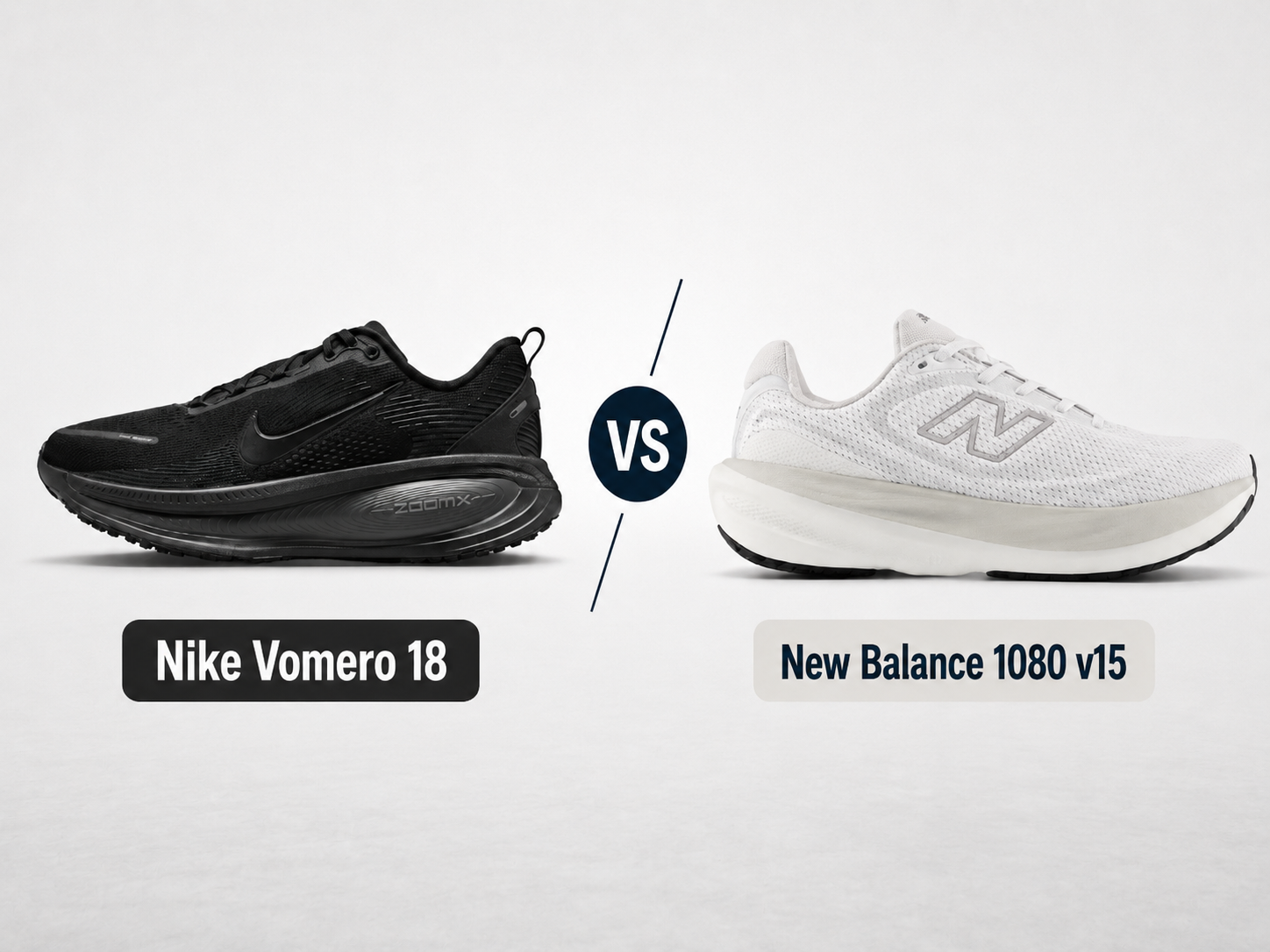
Nike Vomero 18 vs New Balance 1080 v15: Which Daily Trainer Should You Choose?
Nike Vomero 18 and New Balance 1080 v15 are both premium daily trainers, but they feel different when you compare cushioning, weight, stability and everyday running purpose.
In the premium daily trainer category, the New Balance 1080 v15 and Nike Vomero 18 are two highly cushioned shoes designed for easy runs, long runs, walking and everyday mileage.
Instead of only looking at brand reputation or changing market prices, this comparison uses the RunningShoesFinder scoring model to look at five practical dimensions: Cushion, Propulsion, Stability, Lightness and Durability.
Spec Comparison
| Feature | Nike Vomero 18 | New Balance 1080 v15 |
|---|---|---|
| Stack height | 46 mm | 38 mm |
| Midsole softness | Soft | Soft |
| Plate | None | None |
| Rocker geometry | Yes | Yes |
| Stiffness | Moderate | Moderate |
| Weight | 325 g | 261 g |
| Primary category | Daily trainer | Daily trainer |
| Secondary categories | Long run, Walking | Long run, Walking |
| Arch support | Neutral | Neutral |
| Heel counter | Moderate | Stiff |
| Torsional rigidity | Stiff | Moderate |
Radar Score Overview
New Balance 1080 v15: Cushion 5, Propulsion 4, Stability 3, Lightness 3, Durability 4.
Nike Vomero 18: Cushion 5, Propulsion 4, Stability 3, Lightness 1, Durability 5.
At first glance, the two shoes look very similar in cushion, propulsion and stability. However, the key difference appears in the trade-off between lightness and durability-focused structure.
Five-Score Radar Comparison
1. Cushion and Propulsion: Two Strong Daily Trainer Profiles
Cushion: 5/5 for both shoes
Both shoes score strongly for cushioning, but they reach that score in different ways.
The Nike Vomero 18 has a very high 46 mm stack height, which gives it a more protective profile for easy running, recovery runs and long steady mileage. This makes it the more maximum-stack option in this comparison.
The New Balance 1080 v15 has a lower 38 mm stack height, but it still scores highly because of its soft midsole setup. It offers a cushioned daily trainer feel while staying lighter and less bulky than the Vomero 18.
- Vomero 18 = maximum-cushioning protection, above the 40 mm race-legal stack limit.
- 1080 v15 = still very cushioned, but lighter, lower-stack and more practical for everyday use
Propulsion: 4/5 for both shoes
Neither shoe has a plate, so they should not be treated as race-day carbon shoes.
However, both shoes have rocker geometry and moderate stiffness, which can help create a smoother transition from landing to toe-off. This is useful for daily mileage because the shoe can feel easier to roll through at comfortable paces.
The propulsion score does not mean these shoes are aggressive racing shoes. It simply means both shoes have enough geometry and structure to support a smooth daily running rhythm.
2. Stability: Different Structures, Similar Score
Stability: 3/5 for both shoes
Both shoes are neutral daily trainers, so neither should be understood as a full stability shoe. However, they provide support through different design characteristics.
The New Balance 1080 v15 has a stiff heel counter, which may help the rearfoot feel more secure and locked in.
The Nike Vomero 18 has stiff torsional rigidity, which may help the platform feel more structured and resistant to twisting, especially important for a high-stack shoe.
- 1080 v15 = stronger heel structure
- Vomero 18 = stronger torsional structure
For runners who simply need a neutral daily trainer, both can make sense. For runners who need strong motion-control support, neither shoe should be treated as a dedicated stability model.
3. Weight Efficiency vs Material Protection: The Real Trade-Off
Lightness: New Balance 1080 v15 is clearly more efficient
The New Balance 1080 v15 weighs 261 g, while the Nike Vomero 18 weighs 325 g. A 64 g difference is very noticeable in the daily trainer category, especially over longer runs or when the shoe is used for everyday walking as well as running.
This is where the 1080 v15 has a clear advantage. It still delivers a high-cushion daily trainer feel, but it does not feel as bulky or material-heavy as the Vomero 18. For runners who want soft protection without feeling like they are lifting a maximum-stack shoe every step, the 1080 v15 is the more weight-efficient option.
In the RunningShoesFinder model, this explains why the 1080 v15 receives a stronger Lightness score. It gives up some maximum structure, but in return it feels easier to use as a smoother everyday shoe.
Durability: Vomero 18 benefits from a heavier, more protective build
The Nike Vomero 18 scores higher for Durability in the RunningShoesFinder model because its design is more material-heavy and protection-focused. It is not trying to be a lightweight daily trainer. Its identity is based on maximum cushioning, high-stack comfort and a more substantial training-shoe structure.
This higher durability score should not be read as a guaranteed lab-tested mileage number for every runner. Running form, body weight, surface, weather and outsole wear pattern can all change the real lifespan of a shoe. However, from a scoring-model perspective, the Vomero 18 has several durability-friendly signals: higher weight, more substantial construction and a protective daily-trainer build.
The trade-off is obvious: the extra material that helps the Vomero 18 feel protective also makes it much heavier. That is why it scores strongly for Durability but poorly for Lightness.
New Balance 1080 v15: lighter, but still durable enough for daily training
The New Balance 1080 v15 still scores well for Durability, but it reaches that score in a different way. It is not built like a heavy protective tank. Instead, it aims for a better balance between soft cushioning, reduced weight and everyday comfort.
This makes the 1080 v15 easier to recommend for runners who want one comfortable daily shoe that can handle easy runs, walking, long travel days and general mileage without feeling overly heavy.
- New Balance 1080 v15 = better weight efficiency, softer daily comfort and easier everyday use.
- Nike Vomero 18 = heavier, more protective and stronger in the durability-focused scoring model.
- The main trade-off is not simply light vs heavy. It is efficiency vs protection.
Final Verdict: Which Shoe Should You Choose?
If you want a lighter, softer and more versatile daily trainer, the New Balance 1080 v15 is the better direction. It gives you strong cushioning without the heavy feel of a maximum-stack shoe, making it a good choice for daily running, walking, long travel days and general mileage.
If you want maximum-stack protection and a more substantial daily trainer, the Nike Vomero 18 is the better direction. It sacrifices lightness, but gives you a higher 46 mm stack height, strong underfoot protection and a more structured build.
- Choose New Balance 1080 v15 if you value lightness and everyday comfort.
- Choose Nike Vomero 18 if you value protection, structure and durability-focused mileage.
Check Availability
Price and size availability can change, so it is worth checking current options after you know which shoe fits your running purpose.
Still Not Sure Which Shoe Fits You?
Running Shoes Finder compares shoes by Cushion, Propulsion, Stability, Lightness and Durability, so you can choose based on purpose instead of only brand, hype or price.
Some product links may be affiliate links. If you buy through them, RunningShoesFinder may earn a small commission at no extra cost to you.