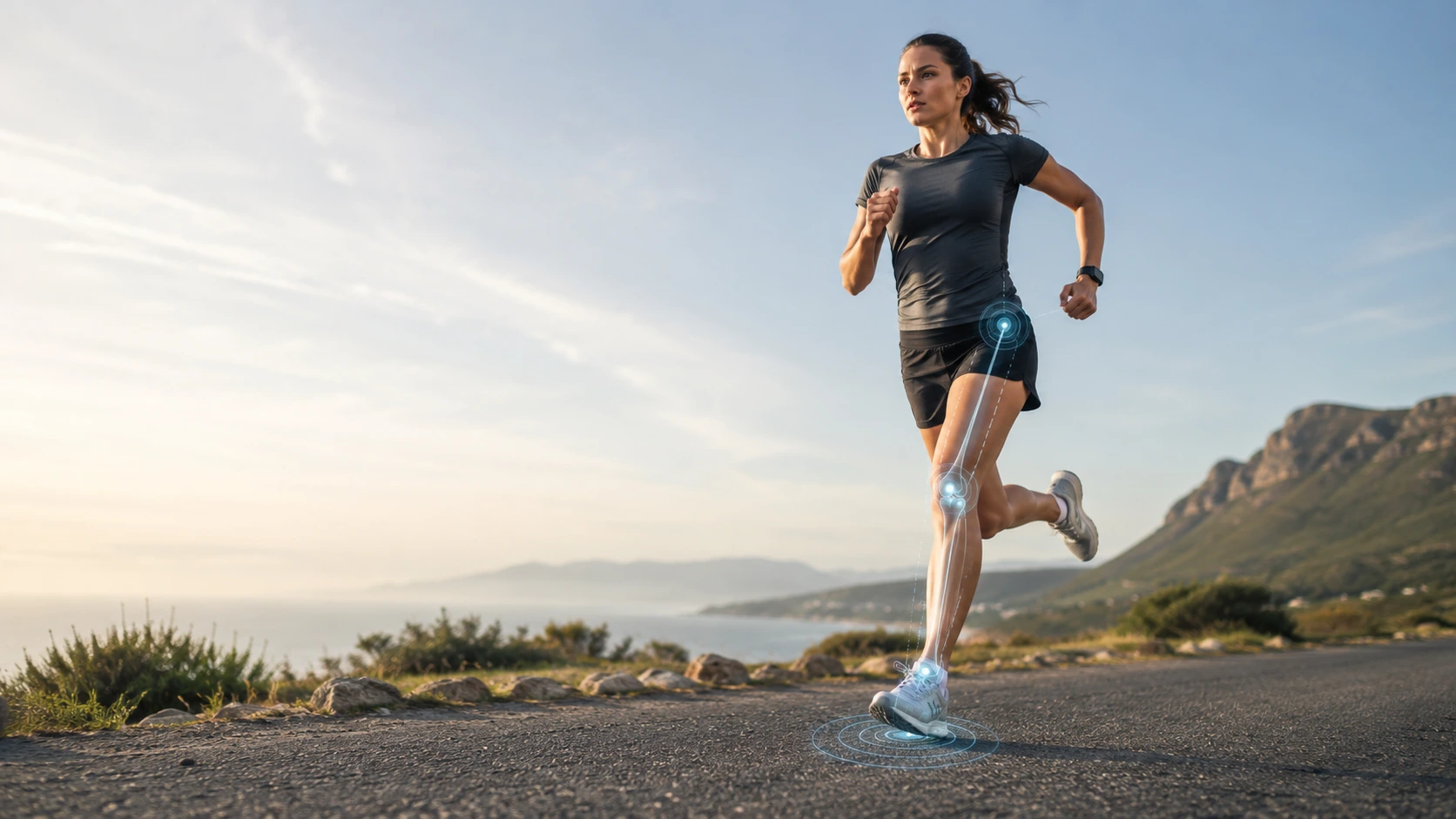
You Train Endurance, Strength and Speed — But Have You Trained This Hidden Running Skill?
Most runners train endurance, strength and speed, but proprioception is the hidden skill that helps your body control each landing.
Most runners train endurance. Some train strength. Many chase speed, better shoes, smarter pacing, race strategy, nutrition, and recovery.
But there is one hidden running skill that many runners rarely think about: proprioception.
Proprioception is your body's ability to sense where your joints are without needing to look. For runners, it means your foot, ankle, knee, hip, and brain can work together to understand where your body is when you land.
Running may look simple from the outside: one foot lands, then the other. But every step is actually a short single-leg landing. In that small moment, your body has to stabilise, absorb impact, control direction, and prepare for the next stride.
That control does not only come from fitness. It also comes from your nervous system.
Many runners talk about stability, especially when choosing running shoes. But stability is only the visible result. Proprioception is the hidden sensor system behind it.
If your foot and ankle can sense position well, your body can react quickly when the surface changes, when you get tired, or when your stride becomes less controlled.
If that system is not sharp enough, your body may compensate. That compensation can feel like foot fatigue, toe gripping, tight calves, unstable landing, one-sided knee discomfort, or reduced confidence on uneven roads.
Sometimes a knee problem is not only a knee problem. It may start lower down, from the foot and ankle not controlling landing efficiently.
This is also why mobility is not the same as control. You may be able to rotate your ankle and feel recovered from an old sprain, but that does not always mean your foot and ankle can control landing well under fatigue, speed, or uneven ground.
A simple self-check is single-leg balance. Stand on one foot and notice: does one side feel harder? Do your toes grip the ground? Does your arch collapse? Does your knee drift inward? Does closing your eyes make it much harder?
This is not about proving you are weak. It is about discovering how well your body controls landing.
Running shoes cannot replace proprioception, but they can support or expose your control. A shoe may feel stable because it has a wider platform, secure heel lockdown, good upper structure, controlled midsole softness, or enough torsional rigidity.
The best shoe is not always the softest, lightest, or fastest-looking shoe. The best shoe is the one that works with your body, your landing style, and your training needs.
At RunningShoesFinder.com, we look at shoes through real trade-offs: cushioning, propulsion, stability, lightness, durability, and how a shoe may feel for different runners.